Taking fruit off on purpose
You pulled the blossom through, kept the bees on, and waited for set — and now you're going to remove most of it. That is not failure. That is the plan.
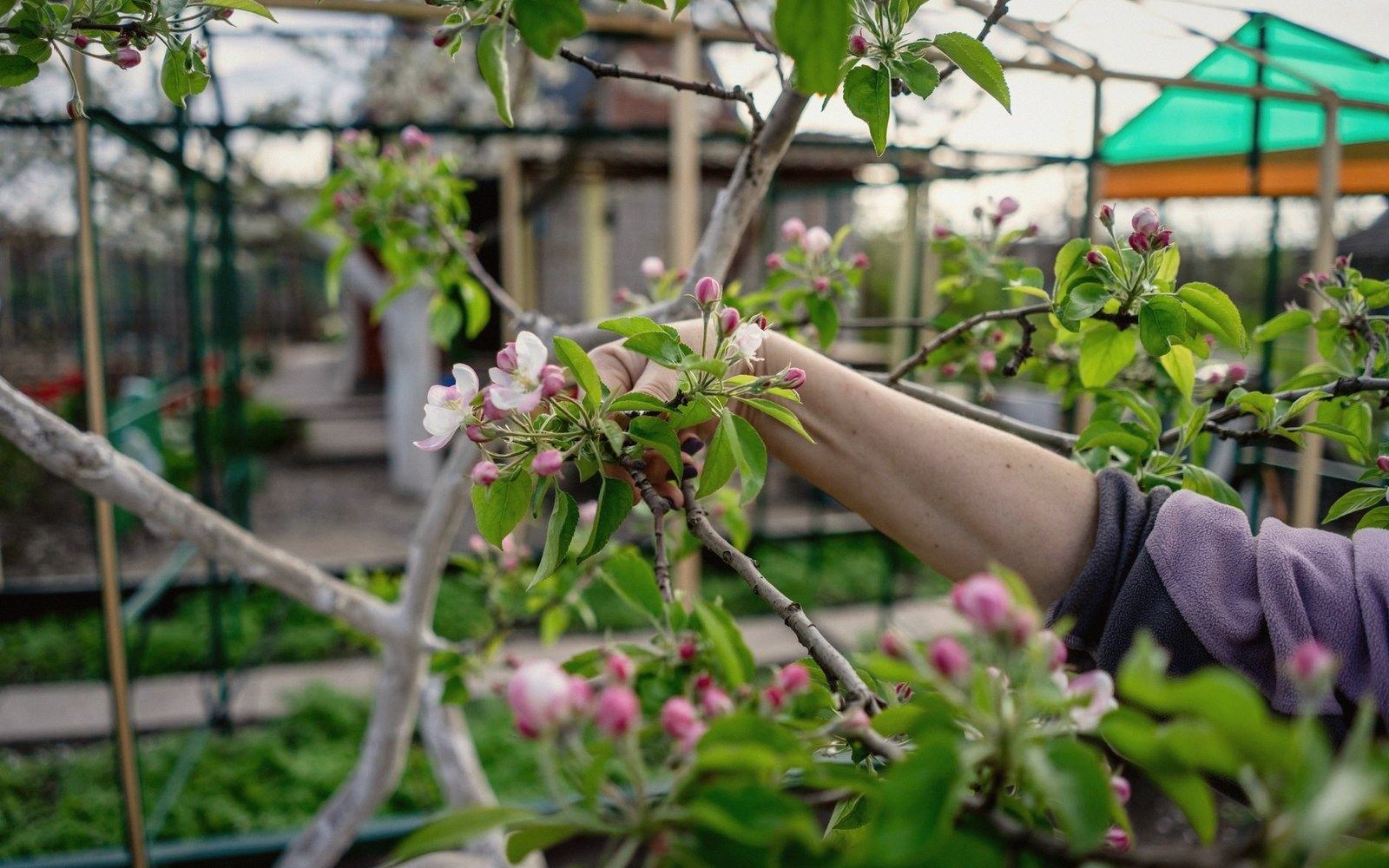
Removing most of what set, to get size, return bloom and a crop next year too.
Why the tree cannot do it alone
A well-managed apple or pear on a modern dwarfing rootstock will set far more fruitlets than it can carry to useful size. The flowers are generous and the bees thorough, but the tree has a fixed photosynthetic budget. Spread that budget across sixty fruitlets and you get sixty undersized, poorly colored apples that return almost nothing at the packhouse. Concentrate it on twenty-five and you get twenty-five worth selling.
The tree attempts its own correction: the june drop in early summer sheds some of the weakest fruitlets as the embryonic seeds inside them fail to compete for hormones. But the natural drop is unpredictable, often too conservative, and always too late for the grower's purposes. By the time the tree has finished shedding what it will shed, the remaining fruitlets have already been in competition for weeks. Size has already been lost.
Thinning is the intervention that replaces the tree's rough judgment with something deliberate. Done at the right moment — typically within four to six weeks of full bloom, while fruitlets are still small and the season's carbohydrate demand is low — it redirects resources early enough to make a real difference to final fruit caliber.
What is actually being decided
Three things are settled by a thinning pass, not one.
Size this year. Fewer fruitlets competing for the same leaf area means each one reaches a larger diameter at harvest. Market specifications for premium apple grades begin at 65 mm or above in most systems; fruitlets left crowded rarely achieve it.
Return bloom next year. The seeds developing inside a fruitlet produce gibberellins — hormones that suppress flower initiation for the following season. A tree carrying a heavy crop in one year will often initiate almost no flower buds for the next, producing the classic alternating pattern known as biennial bearing. Reducing fruit load during the window before flower bud initiation — which closes by midsummer — breaks that cycle. The cost of thinning is paid partly in this year's volume; the return is a crop the year after.
- Size this year
- fewer fruitlets, more carbohydrate per fruit
- Return bloom
- thinning before midsummer prevents gibberellin suppression of next year's flower buds
- Spur health
- sustainable annual load preserves long-term productivity
Spur health. A spur system asked to mature too many fruits each year exhausts itself. Long-term spur quality, the productive capital of the tree, depends on a sustainable annual load.
The decision of how heavily to thin is variety-specific and planting-specific. A variety prone to biennial bearing, such as Bramley's Seedling, demands aggressive thinning. A steady cropper on a vigorous site can be left heavier. The grower is reading the tree and the economics simultaneously.
Where each fruitlet falls in the cluster
Not every fruitlet in a cluster is equal. The king bloom — the central flower, which opens first — produces the king fruit. It is typically larger, better shaped and sets earlier than the surrounding satellites. Sound thinning practice removes the satellites and retains one fruit per cluster, and that fruit should, wherever possible, be the king. Where the king has been damaged — by frost or a late pest flush — the next best satellite is kept instead, but the crop is already compromised. The cluster spacing on the branch then becomes the secondary consideration: standard guidance keeps one fruitlet roughly every ten to fifteen centimetres of spur-bearing wood, though the number that translates to varies by the tree's expected yield.
The methods used — hand removal, chemical thinning, or mechanical blossom disruption — each carry their own cost and precision profile, and those trade-offs run deep enough to deserve their own treatment. What matters here is that the decision to thin, and the timing of it, are not adjustable. Miss the window by two weeks and the endocrine signals have already been sent; next year's bloom is already being suppressed. A late thinning still improves this season's size, but it does not recover the return bloom. The tree has already decided.
This is the nature of every critical intervention in an orchard: it takes place in a small window, and what you do inside that window shapes the following twelve months, not just the following harvest.
The grower is reading the tree and the economics simultaneously.
- Effective thinning window
- within four to six weeks of full bloom
- Flower bud initiation closes: midsummer
- the hard deadline for biennial-bearing benefit
- June drop
- natural, unreliable, typically too late to fully substitute for deliberate thinning
Filed under Thinning · boydorchards.com