The rootstock decides
Below the graft union, a single choice sets tree size, cropping age, how deep the anchors must go, and whether the planting ever pays.
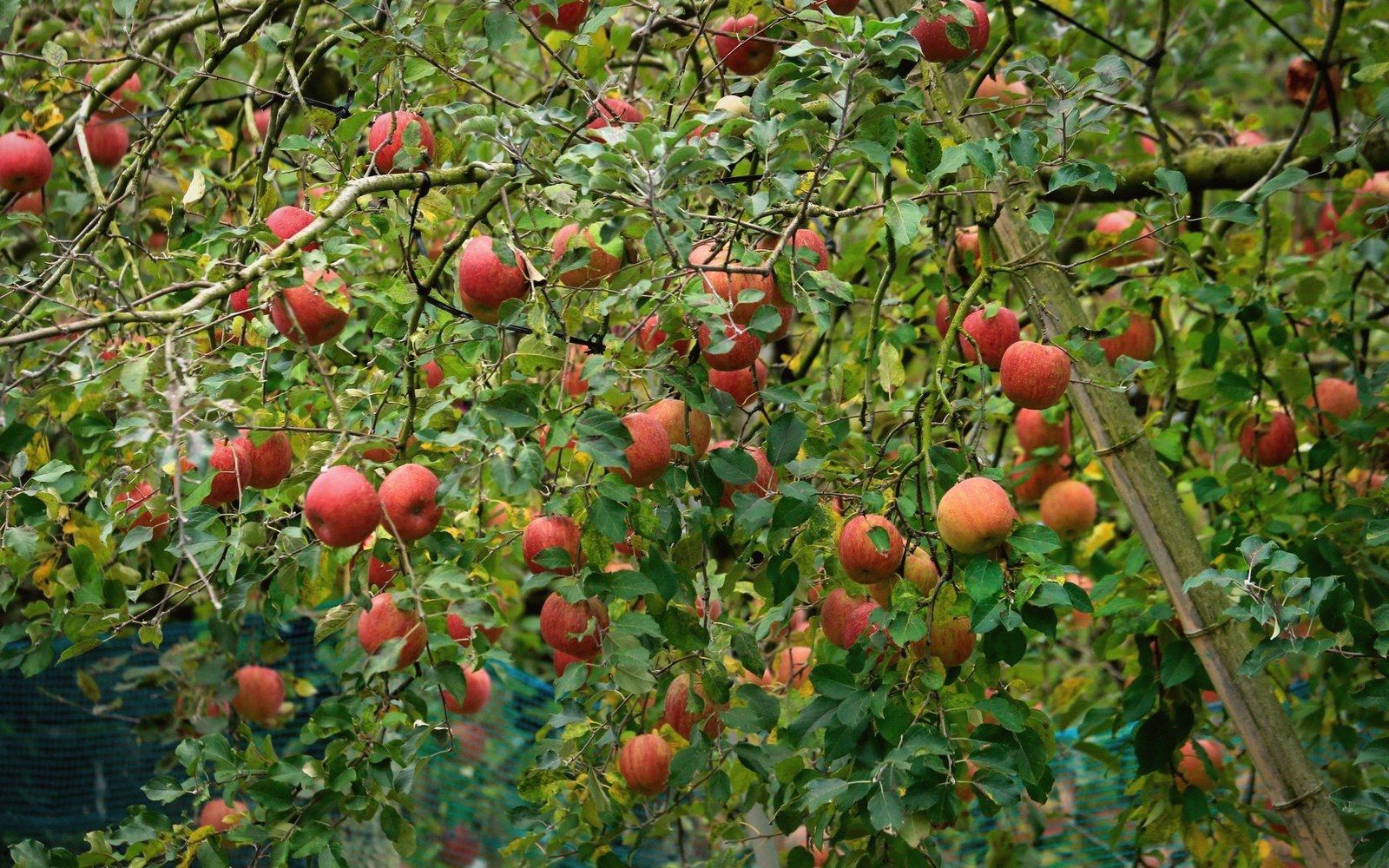
Size, precocity, anchorage and how long the tree takes to pay for itself are all set below the graft. The scion supplies the fruit and almost nothing else.
What the scion does not supply
Walk along a modern apple block — trees on wires, spaced tight, every trunk barely a thumb's width from its neighbour — and your eye goes to the fruit. The variety is what the grower sells, what the buyer asks for by name, what the breeder spent two decades selecting. It is also, in the architecture of the tree, almost beside the point. The scion supplies the fruit character: flavour, colour, skin texture, harvest window. It supplies almost nothing else. The tree's size, its vigour, how early it bears, how firmly it stands in wet soil, how much it costs to establish — all of that is decided below the graft union.
This is not a recent discovery. Growers in Roman-era cultivation knew that the same variety budded onto different understocks behaved differently. The modern science is more precise, and the stakes are higher, because today's high-density orchards are capitalised so heavily that a rootstock choice made before planting can determine whether an investment returns in year six or year fourteen.
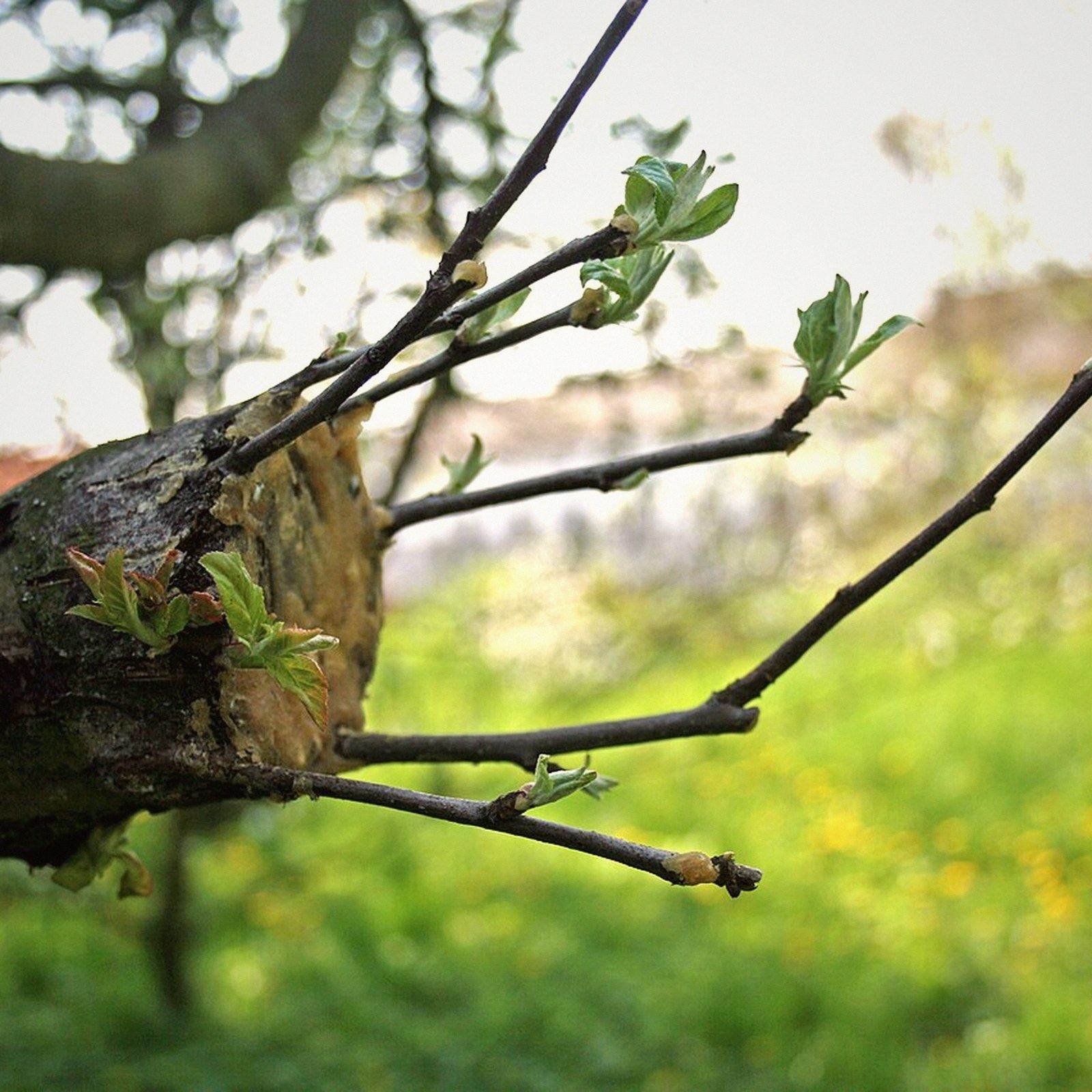
The four things the rootstock controls
Vigour — and what it really means. Rootstock vigour is commonly described as tree size, which is accurate but incomplete. A vigorous rootstock — MM.111, say, or a seedling — drives strong shoot growth, builds a large canopy and takes years to settle into productive bearing. A dwarfing stock like M.9 (Malling 9, the dominant rootstock in commercial apple production worldwide) restricts that growth hard. The tree on M.9 stays small: in a modern tall-spindle planting, seldom taller than three metres. That smallness is not a cosmetic preference. It is the condition that makes high-density planting physically possible, that makes hand-harvesting without ladders feasible, that concentrates the tree's energy into fruit rather than wood.
Dwarfing is a restriction in a literal physiological sense. Something at or near the union — the mechanism is still not fully resolved, but involves altered hormone and carbohydrate movement — limits what the rootstock delivers to the scion and what the scion returns below. The result is a tree that never builds the framework its own genetics would otherwise demand.
Precocity. A dwarfing stock forces the tree into bearing early, often within two to three years of planting. A vigorous stock may take six or seven years before it crops meaningfully. This matters enormously to cashflow. A grower who plants M.9 at 3,000 trees per hectare has spent heavily on trees, trellis, wire, anchors and labour before a single bin is picked. Every year of delay before that planting produces commercially is a year of carrying costs without income. Precocity is not simply a biological convenience; on a modern capital-intensive block, it is a financial necessity.
- Scion
- supplies fruit character; variety name, colour, flavour, harvest date
- Rootstock
- supplies everything structural: vigour level, cropping age, anchorage, soil behaviour
- M.9 (Malling 9)
- dominant commercial dwarfing stock; shallow-rooted, non-anchoring, highly precocious
- MM.106 / MM.111
- semi-vigorous stocks from the East Malling / John Innes collaboration; better anchorage, wider soil tolerance
- Geneva series
- Cornell University rootstocks; high-density compatible with replant-disease resistance
- Precocity
- how early a tree first bears commercially; directly tied to rootstock vigour class
- Replant disease
- soil pathogen complex that suppresses new apple trees planted on old apple ground
Anchorage. M.9 has a shallow, fibrous root system. It does not anchor. A tree on M.9 in a January gale will move, lean and eventually fall unless it is mechanically supported — which is exactly why modern high-density orchards are built as posts and four wires: the trellis is doing the structural work the root system cannot. On MM.106 or MM.111, by contrast, the tree builds a root plate wide and deep enough to stand without wire support, which is why those stocks were the standard for traditional low-density plantings that needed no trellis at all. The rootstock choice and the infrastructure choice are the same decision, made simultaneously.
Soil adaptation. MM.106 tolerates a wider range of soils and handles moderate drought reasonably well, which made it the workhorse of the British industry for decades after it was released by East Malling and the John Innes Institution in the 1950s. M.9, developed at East Malling in Kent from older French material, needs well-drained, fertile soil and irrigation; without water in a dry summer, the trees under stress will drop fruit and struggle to set a return crop. Geneva series rootstocks, developed at Cornell University in New York State, have extended the range of what high-density planting can tolerate, adding resistance to replant disease — the complex of soil pathogens that builds up where apples have grown before — which is a serious limiting factor when orchards are grubbed and replanted on the same ground.
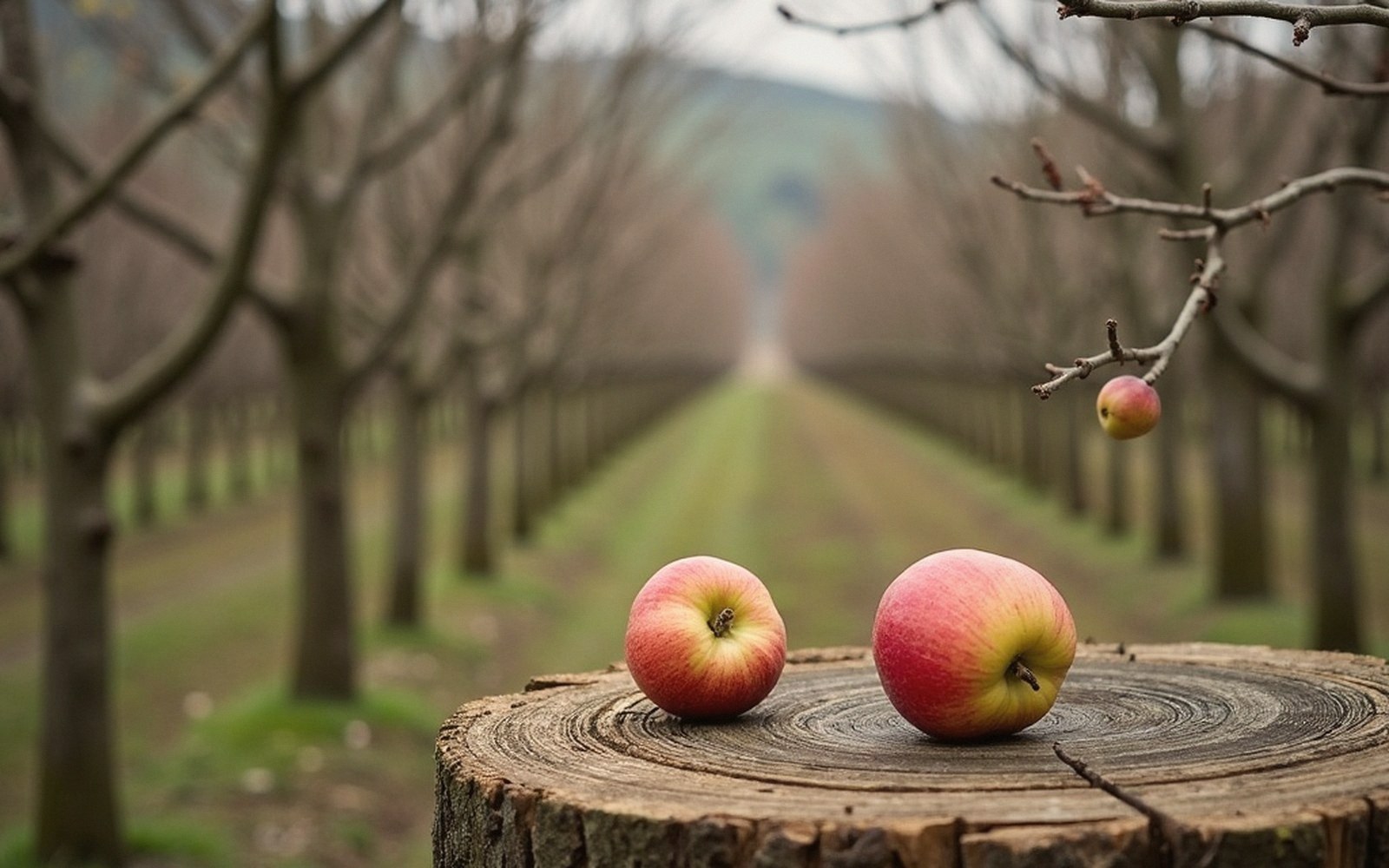
The arithmetic of establishment
Consider what the rootstock choice commits a grower to before a tree is in the ground. M.9 at high density means thousands of trees per hectare, each needing an individual stake or a shared trellis wire. End posts must be anchored against the aggregate pull of every wire in the row. The screw anchors, the strainer posts, the irrigation lines — none of this infrastructure would exist, or would be affordable to amortise, if the trees were planted at fifty to the hectare on seedling roots. The capital per hectare is an order of magnitude higher. The return per hectare — in yield, in fruit quality, in the ability to pick quickly and get fruit to controlled-atmosphere storage before condition deteriorates — is also an order of magnitude higher, when the system works.
When it does not work, the rootstock is often where the failure began. Planted too deep, M.9 encourages the scion to form its own roots, which grow vigorously and quietly undermine the dwarfing effect. The tree that was supposed to stay at three metres climbs toward six. The density that was supposed to justify the trellis investment becomes unworkable. All of that starts with a graft union buried below the soil line when it should be kept clear above it.
The scion is what the grower names the orchard after. It is the commercial identity of the block: the variety on the label, the fruit in the bin. But the rootstock is what the grower is actually managing — the size of every intervention, the timing of every first crop, the reason the wires are there at all. A different rootstock on the same scion makes a different orchard. The scion is almost a passenger.
A different rootstock on the same scion makes a different orchard.

- M.9 at high density
- commonly 3,000+ trees per hectare in a modern tall-spindle block
- Traditional seedling/vigorous stock
- as few as 50–100 trees per hectare
- First commercial crop on M.9
- typically years 2–3 after planting
- First commercial crop on vigorous stock
- may be year 6–7 or later
- Maximum practical tree height on M.9 tall-spindle system
- around 3 metres
Filed under Union · boydorchards.com