The union must stay clear
The graft union sits above the soil for a reason. Bury it and the scion takes over — and everything rootstock selection was meant to achieve disappears.
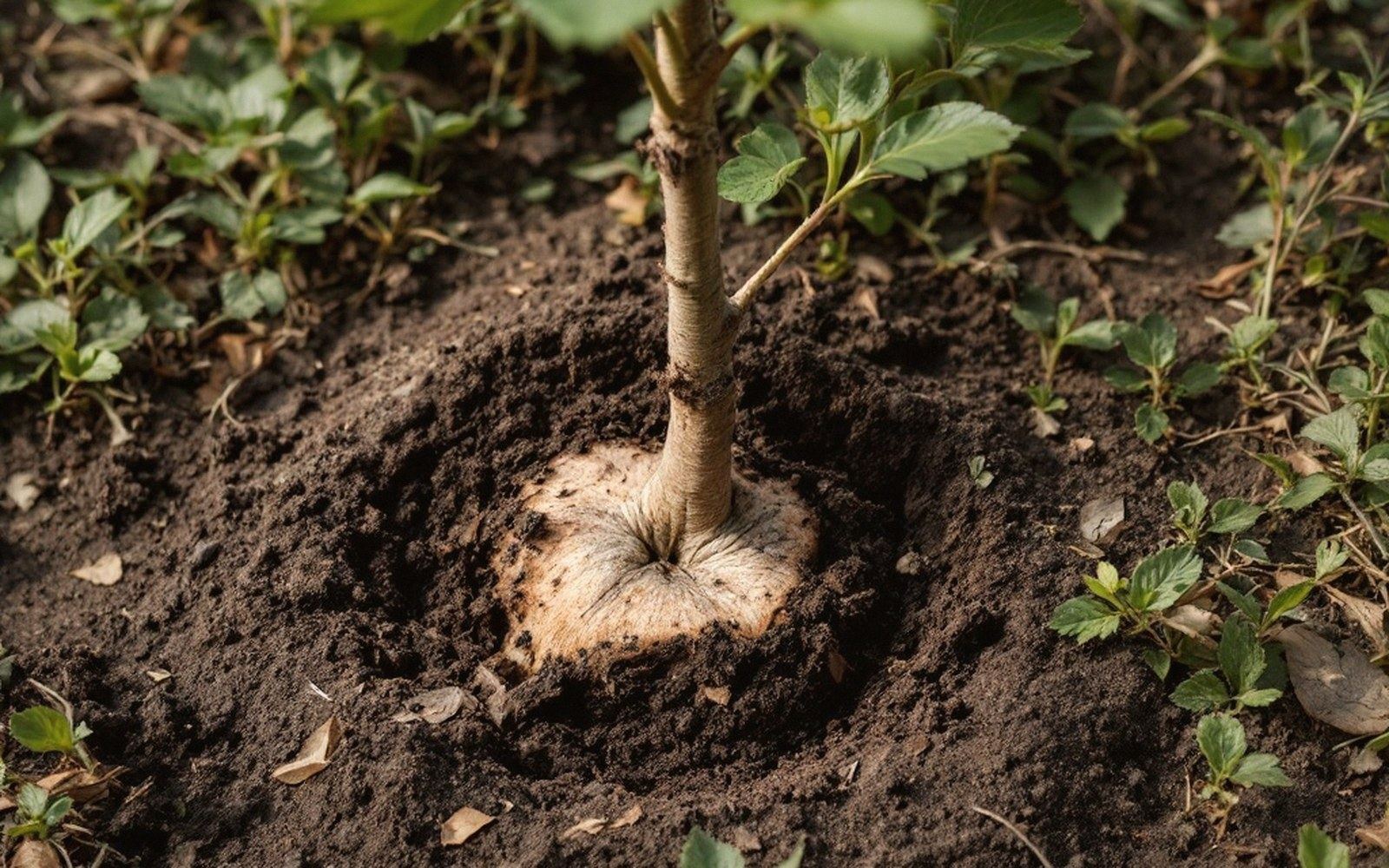
Planted too deep, the scion roots and the whole point is lost.
One mark that must not be covered
There is a swollen line partway up the base of every young tree — the callus ridge where rootstock and scion knitted together. It looks like an afterthought, a slight thickening in the bark. In practice, it is the most important mark on the tree, and it needs to stay in plain sight.
The union must sit above the soil surface. Most growers aim for a clearance of at least two or three inches, which is enough to survive settling after planting and the slow creep of mulch or cultivated earth that can accumulate in a row over several seasons. Some specifications call for a little more.
The reason is straightforward. If the union is buried, the scion — the variety grafted onto the top — will eventually put out its own roots. Once the scion establishes direct contact with the soil, it starts feeding itself. The rootstock beneath it becomes irrelevant.

This matters because everything the rootstock was chosen to deliver — final tree size, precocity, anchorage and how long the tree takes to pay for itself — is mediated through that union. A dwarfing stock works by restricting the movement of carbohydrates and growth regulators across the graft. Bypass it with scion roots and you no longer have a dwarfed tree. You have, depending on the variety, something substantially larger than the system was designed to carry — wrong spacing, wrong wire height, wrong cropping assumption, wrong economics.
On a dwarf or semi-dwarf high-density planting where trees stand less than a metre apart, a single tree rooting on its own scion may take years to become obvious, but the consequences are structural. Adjacent trees get shaded before they are supposed to, trellis loads shift, and the uniformity that makes mechanised management possible starts to break down.
Checking the union is a task for planting day and again each spring. If soil has crept up, it is pulled back. If a tree is settling unevenly — common on lighter soils — the union level is re-examined before it becomes a problem. It takes a minute. Missing it can cost a season or more to correct, and in some cases the tree is simply replaced.
- Union clearance at planting
- two to three inches above final soil level, at minimum
- After settlement
- re-check the first spring; light soils move more than expected
- Annually
- mulch and cultivated soil accumulate; pull back anything covering the union
- Scion rooting
- look for roots emerging at or above the union; if found, the tree's rootstock characteristics are compromised
The mark is there. Keep it above ground.
Bypass it with scion roots and you no longer have a dwarfed tree.
Filed under Union · boydorchards.com